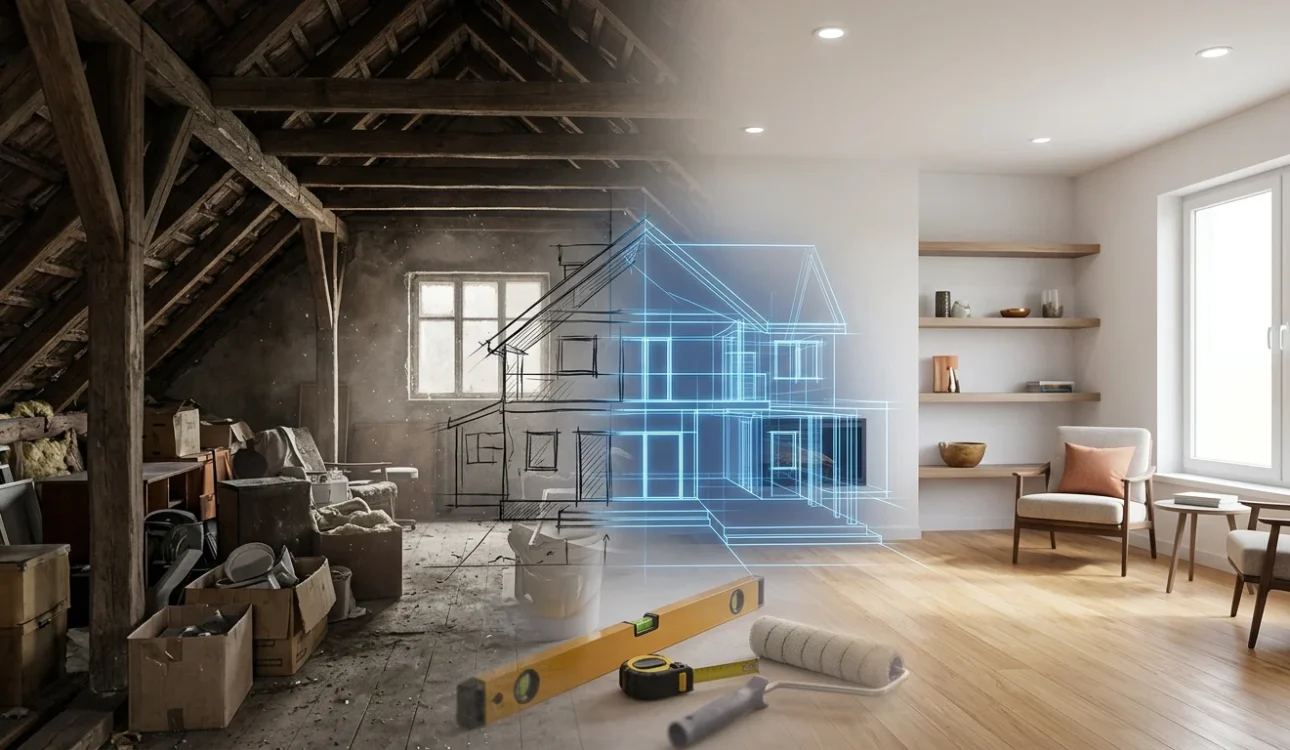
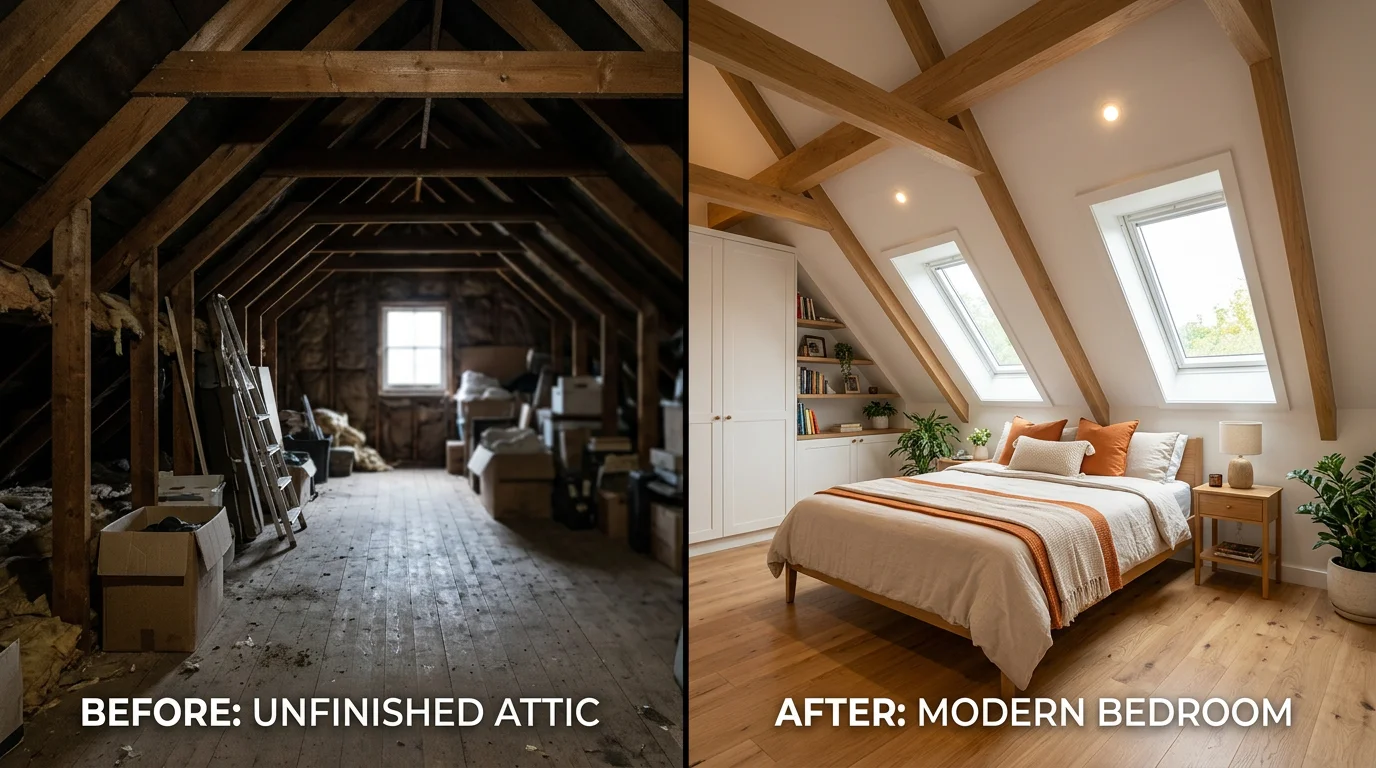
An unused attic represents one of the most underutilized assets in modern homes. While most homeowners view this shadowy space as storage-only territory, the reality is far more transformative. Attic conversions unlock square footage that already exists within your property's footprint—no expensive foundation work, no land acquisition required. This makes attic remodeling one of the most cost-effective ways to expand your living area and reclaim space for the activities and people you value most.
Quick Answer: Attic before and after remodels can transform wasted overhead space into functional bedrooms, home offices, or recreation areas, typically adding 20-40% more usable square footage to your home. An attic conversion not only increases property value but also creates the breathing room families need without the expense of traditional additions. Whether you're seeking a quiet workspace or guest quarters, finished attic space delivers measurable returns on investment.
The transformation potential lies not just in square footage gained, but in how that space reshapes your daily life. A properly executed attic conversion addresses the fundamental challenge homeowners face: creating more room for what matters without relocating or undertaking massive construction. Our approach at WAREMODEL focuses on maximizing this hidden potential through thoughtful design and strategic planning. This guide walks you through the entire journey—from assessing feasibility to witnessing your attic's stunning metamorphosis into a space that genuinely enhances your home's functionality and market appeal.
Table of Contents
- Planning Your Attic Remodel: Essential Steps Before You Start
- Popular Attic Remodel Ideas: From Bedrooms to Creative Studios
- Critical Design Elements That Make Attic Remodels Successful
- Electrical, Plumbing, and Structural Upgrades Your Attic Needs
- Common Questions About Attic Remodels Answered
- Start Your Attic Transformation With Confidence
Planning Your Attic Remodel: Essential Steps Before You Start
Before breaking through drywall or ordering materials, successful attic remodeling demands a methodical assessment phase. This foundation determines whether your project will proceed smoothly or encounter costly surprises mid-construction. The planning stage typically takes two to four weeks and involves structural evaluation, regulatory compliance, budget alignment, and contractor selection—each critical to transforming your vision into reality.
Structural Assessment & Building Code Compliance
Your first step is determining whether your attic can legally become living space. Building codes typically require attic living spaces to have at least 7 feet of ceiling height over a minimum of 50% of the required floor area, with ceiling heights of at least 5 feet across that floor area. Many older homes fall short of these standards, necessitating structural modifications like roof reinforcement or dormer installation. Hire a structural engineer ($300–$800) to evaluate load-bearing capacity, roof framing, and floor joists. This assessment prevents code violations and identifies whether your attic renovation planning requires permits—which it almost certainly does. Local building departments enforce these standards rigorously; skipping permits creates liability and complicates future home sales.
Budget & Timeline Establishment
According to Angi's cost analysis, the average cost to finish an attic in 2026 ranges from $7,500 to $35,000, with most homeowners paying around $20,000. Costs typically fall between $30 and $60 per square foot for standard tasks including drywalling, insulation, and HVAC. Premium additions like dormer windows ($12,000 each) or custom finishes push budgets higher. Basic attic renovations typically take four to eight weeks, while extensive remodels involving structural changes extend timelines to several months. Establish a realistic contingency fund (15–20% above estimates) for unexpected issues—hidden water damage, inadequate electrical service, or ventilation problems frequently emerge once work begins.
Contractor Selection & Project Planning
Interview three to five licensed contractors with attic-specific experience. Request references from completed projects, verify insurance and bonding, and obtain detailed written estimates. At WAREMODEL, we emphasize that thoughtful planning with qualified professionals prevents costly missteps and ensures your finished space meets both code requirements and your functional needs. Ask contractors about their approach to ventilation, insulation, and egress windows—these details separate mediocre conversions from truly functional living areas. Establish a written contract specifying scope, timeline, payment schedule, and warranty terms before any work begins.
Popular Attic Remodel Ideas: From Bedrooms to Creative Studios
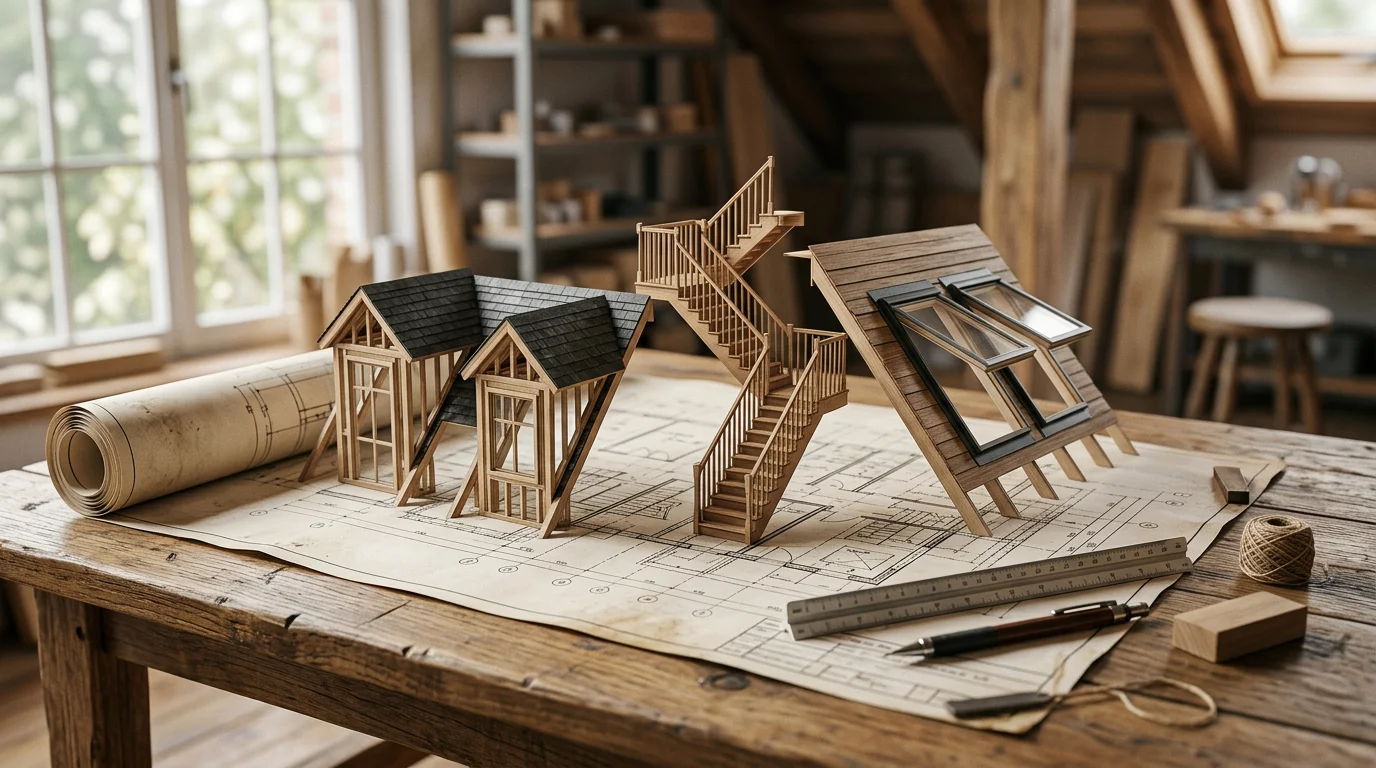
Your attic's sloped ceilings and unique geometry aren't limitations—they're design opportunities. The key is matching the space to a purpose that thrives within those constraints. Here are six proven transformation concepts, each grounded in practical design principles that turn awkward square footage into genuinely functional living areas.
Master Bedroom or Guest Suite
An attic bedroom capitalizes on privacy and separation from main living zones. Position the bed perpendicular to the roofline to maximize headroom, and use the lower wall sections for built-in storage or seating nooks. Ensure at least one egress window (required by code) doubles as natural light and emergency exit. Sloped ceilings feel intimate rather than cramped when paired with soft, layered lighting and neutral wall colors that visually expand the space.
Home Office or Study
A dedicated workspace in the attic eliminates household distractions and creates professional boundaries. Position your desk facing a window for natural light and psychological benefit. Attic offices work exceptionally well for freelancers, consultants, or remote workers who need separation from family activity. Install adequate electrical outlets before drywall goes up—retrofitting is expensive and messy. Proper ventilation prevents heat buildup during summer months, which is critical for equipment longevity and comfort.
Playroom or Recreation Zone
Attic playrooms suit children and families because the lower ceiling heights feel appropriately scaled for younger users. Soft flooring (cork, foam tiles, or carpet) cushions falls and reduces noise transmission to rooms below. This space naturally encourages imaginative, contained play without the formality of main-floor living areas.
Reading Nook or Library
Low-light, quiet attics become perfect retreats for book lovers. Built-in shelving along sloped walls maximizes storage while following the architecture. A comfortable chair, warm lighting, and thermal insulation create a sanctuary that feels separate from daily household rhythm.
Creative Studio (Art, Music, Craft)
Artists, musicians, and makers benefit from dedicated studio space with controlled light and minimal interruption. Skylights or dormer windows provide consistent natural illumination without glare. Concrete or sealed plywood flooring tolerates spills and heavy equipment better than finished surfaces.
Media Room or Entertainment Space
An attic media room takes advantage of isolation for sound control. Proper insulation and acoustic treatment minimize noise escape to lower floors. Blackout window treatments support projection screens and create theater-like ambiance.
Each concept succeeds when ventilation, egress, electrical capacity, and insulation are addressed during planning. As you explore these attic renovation ideas, WAREMODEL's approach emphasizes matching your chosen function to the space's natural strengths, ensuring your finished attic becomes a genuinely livable extension of your home rather than an afterthought storage area.
Critical Design Elements That Make Attic Remodels Successful
The difference between a mediocre attic conversion and an exceptional one hinges on five interconnected design decisions made during planning. These elements work together to transform raw, uncomfortable space into genuinely livable square footage that feels integrated with the rest of your home rather than an afterthought addition.
Natural Light and Attic Lighting Design
Skylights and dormer windows are non-negotiable for successful attic spaces. Standard ceiling fixtures alone create a cave-like atmosphere that makes even well-insulated rooms feel claustrophobic. Strategic placement of skylights along the roof ridge provides consistent illumination without creating glare on work surfaces or screens. Dormer windows offer dual benefits: they flood corners with daylight while creating vertical wall space for furniture and storage. Layered lighting—combining natural sources with recessed fixtures and task lighting—allows occupants to adjust ambiance throughout the day.
Thermal Comfort Through Proper Insulation
Most climate zones require attic insulation R-values between R-38 and R-60, with northern states (Climate Zones 6-8) requiring R-49 to R-60 for optimal energy efficiency, according to USA Insulation. However, R-value alone doesn't guarantee comfort. Air sealing around penetrations, proper ventilation channels, and vapor barriers prevent moisture accumulation that degrades insulation performance over time. Many homeowners overlook the attic floor—insulating between joists creates a thermal break that prevents conditioned air from escaping to unconditioned spaces below.
Moisture Prevention and Durability
Attics are moisture magnets due to temperature differentials and roof exposure. Adequate ventilation prevents condensation buildup that warps finishes and promotes mold growth. Vapor barriers on the warm side of insulation, combined with soffit and ridge venting, create airflow that naturally dries the assembly. Selecting moisture-resistant ceiling finishes—such as moisture-rated drywall or fiber-reinforced panels—protects against seasonal humidity swings.
| Design Element | Premium Approach | Budget-Conscious Trade-off | Performance Impact |
|---|---|---|---|
| Skylights | Multiple skylights with thermal breaks | Single fixed skylight | 30–50% more natural light vs. fixtures alone |
| Insulation | Spray foam + batt hybrid | Batt insulation only | Superior air sealing; higher upfront cost |
| Ceiling Finish | Moisture-rated drywall + primer | Standard drywall | Prevents mold; extends finish lifespan 15+ years |
| Flooring | Engineered hardwood or luxury vinyl | Plywood subfloor only | Comfort, durability, and aesthetic cohesion |
| Attic Storage | Built-in shelving with climate control | Loose shelving units | Protects stored items; maximizes usable floor area |
Storage Integration and Functional Layout
Built-in shelving and cabinetry maximize usable floor space while keeping clutter organized. Low-profile storage along eaves—where ceiling height is limited—reclaims otherwise wasted perimeter. When WAREMODEL designs attic conversions, the team prioritizes storage solutions that don't compete with living space, ensuring the finished room feels open rather than cramped.
Aesthetic Finishes That Tie It Together
Sloped ceilings demand thoughtful color selection. Light, neutral tones on angled surfaces create visual expansion, while darker accent walls on vertical sections add definition. Flooring should match or complement the rest of your home—discontinuous materials signal a disconnected space rather than a seamless extension.
Electrical, Plumbing, and Structural Upgrades Your Attic Needs
Transforming an attic into functional living space demands far more than aesthetic choices—the invisible infrastructure determines whether your finished room is safe, comfortable, and code-compliant. Electrical systems, plumbing considerations, and structural reinforcement form the foundation of any successful attic conversion, yet many homeowners underestimate their complexity and cost.
Electrical Systems and Capacity
Your home's electrical panel likely wasn't designed to support a fully finished attic with multiple outlets, lighting circuits, and climate control. Most panels operate at or near capacity, meaning an attic remodel requires either a panel upgrade or strategic circuit redistribution. Attic electrical work typically involves running new circuits through walls and ceilings to power outlets, switches, and fixtures—a task that demands precision to avoid fire hazards and code violations. Placement matters significantly: outlets should be positioned to serve furniture arrangements without reliance on extension cords, while lighting circuits need separate capacity from general-use outlets. According to Angi's cost analysis, electrical upgrades typically range from $1,000 to $3,000 depending on complexity.
Plumbing and Bathroom Considerations
If your attic remodel includes a bathroom, plumbing becomes exponentially more challenging. Running supply lines and drain pipes through finished walls and across joists requires careful routing to avoid structural compromise and future maintenance nightmares. Vent stacks must extend through the roof, and drain lines need proper slope—neither can be improvised. Plumbing costs for bathroom additions range from $1,000 to $10,000, depending on distance from existing lines and whether you're adding a full bath or half-bath.
Stairway Safety and Structural Demands
Attic stairs represent both a code requirement and a structural intervention. Building codes mandate minimum headroom, step dimensions, and handrail specifications—spiral staircases cost up to $18,000, while straight stairs range from $1,000 to $5,000. The staircase opening weakens the floor structure, requiring reinforced framing around the opening. Load-bearing walls cannot be removed or significantly altered without engineered support beams, a critical consideration when planning your layout.
Ventilation and Moisture Control
Proper attic ventilation prevents moisture accumulation that destroys insulation and invites mold. Soffit and ridge vents, or mechanical ventilation systems, must be integrated during framing—retrofitting them later proves costly and ineffective. WAREMODEL's approach prioritizes these systems during the planning phase, ensuring your finished attic remains dry and healthy for decades.
A structural engineer should inspect your attic before any work begins, identifying load-bearing elements and reinforcement needs. This investment—typically $300–$500—prevents costly mistakes and ensures your remodel meets all local building codes.
Common Questions About Attic Remodels Answered
Does finishing an attic increase home value?
Yes, but with realistic expectations. According to the National Association of Realtors' 2025 Remodeling Impact Report, attic conversions to living space recover approximately 67% of project costs at resale. This means a $100,000 investment typically returns $67,000 in added home value—a solid return that also improves daily livability while you own the property. The actual ROI depends on local market conditions, quality of execution, and whether the finished space meets buyer expectations for functionality and code compliance.
What's the typical timeline for an attic remodel?
Most attic conversion projects span 8–12 weeks from permit approval to final inspection, though complexity varies. Simple bedroom conversions with existing roof access may finish faster, while projects requiring structural reinforcement, new staircase installation, or extensive HVAC integration extend the timeline. Permit delays can add 2–4 weeks depending on your municipality. Your contractor should provide a detailed schedule during the planning phase—transparency here prevents costly surprises.
How much does an attic remodel cost?
Budget ranges from $25,000 to $75,000+ for a complete conversion, depending on square footage, structural needs, and finishes. Basic bedroom conversions start around $25,000–$40,000, while premium studios or multi-room layouts reach $60,000–$100,000. Costs include framing, insulation, electrical, HVAC, flooring, and finishing materials. Structural reinforcement, new staircase installation, and code-required ventilation systems add significant expenses. Obtain detailed quotes from multiple contractors—this prevents budget overruns and ensures competitive pricing.
How do I choose the right attic contractor?
Verify licensing, insurance, and references specific to attic work. Ask contractors about their experience with structural engineering, building code compliance, and ventilation systems. Request a written scope of work, timeline, and warranty. WAREMODEL's innovative remodeling approach prioritizes structural assessment and proper planning before work begins—a methodology worth seeking in any contractor. Check online reviews and ask for before-and-after portfolios of completed attic projects.
Will my attic remodel disrupt my daily life?
Expect 8–12 weeks of construction activity, dust, and noise. Contractors typically work 7 a.m.–5 p.m. weekdays. Plan for temporary displacement of stored items, restricted access to certain home areas, and potential HVAC disruption. Discuss a detailed construction schedule with your contractor to minimize inconvenience. Professional crews manage debris removal and site cleanup, but your patience during the process remains essential.
Start Your Attic Transformation With Confidence
Your attic's journey from overlooked storage space to functional living area is entirely achievable—thousands of homeowners complete successful remodels every year. The path forward requires only three foundational steps: honest assessment of your space, consultation with qualified professionals, and commitment to the process.
Begin by evaluating your attic's structural readiness. Measure ceiling height, inspect framing for damage, and document existing electrical and ventilation systems. This preliminary audit clarifies whether your vision aligns with physical reality and identifies potential obstacles before they derail timelines or budgets. Many homeowners discover during this phase that their attic before and after transformation potential exceeds initial expectations once they understand the space's true capabilities.
Partner with an experienced remodeling contractor who demonstrates expertise in attic-specific challenges—structural engineering, code compliance, and ventilation design. WAREMODEL's innovative remodeling approach emphasizes thorough planning and structural assessment before construction begins, a methodology worth seeking in any contractor you evaluate. Request detailed quotes, timelines, and references from multiple candidates to ensure competitive pricing and proven track records with similar projects.
The investment in proper planning prevents costly mistakes and accelerates your timeline toward completion. Within 8–12 weeks of focused construction, your attic transforms into valuable living space that serves your family's genuine needs—whether that's a bedroom, studio, or recreational area. This expansion creates room for the important things in life, adding both square footage and measurable home value.
Take the first step today. Schedule your attic assessment and begin conversations with qualified professionals. Your transformation awaits.